E10 — The relaxation sweep: which step converges the surrogate's mean field, and is "auto" the right default?
| Status | complete, with E10b (the 1000-sweep rerun) and E10c (the shipped budget) |
| Package build | E10: 64edf63 (by the build audit); E10b not recorded |
| Driver / analysis | sim/E10-relaxation.R (E10b: the same driver with --max-sweeps 1000); figures sim/figures-e6e10.R, sim/figures-e15e18.R, sim/figures-study.R |
| Data | results/E10/relaxation.csv (2568 rows), results/E10b/relaxation.csv (846 rows) |
Question
The surrogate proposal needs the expected diversity through time under the current parameters: a fixed point x ← F(x) solved by a backward and a forward Picard sweep. Where the map expands, the sweep diverges and a larger budget makes it worse (a finding of the package audit). Under-relaxation takes a partial step, x ← (1 - \(\omega\))x + \(\omega\)F(x); damping = "auto" starts at \(\omega\) = 1, halves whenever the residual grows, and stops at 1/64. "auto" became the default on one diverging case, one contracting case and three gaussian dd cells. Two of those three gaussian cells converged under relaxation, which raised a second question: can the gate that refuses dd on the gaussian link (.bdi_supported) open? That depends on whether the proposal built on a converged mean field is usable, so E10 also samples from it. A first grid with \(\beta\)0 = 0.5 and \(\rho\) = 1 converged at \(\omega\) = 1 in all 54 cells and could answer neither question; the divergences on record need a high absolute rate and, for the gaussian case, incomplete sampling, so both became axes.
Design
| parameter | value | meaning |
|---|---|---|
| tips | 50, 150, 400 | target size of a dd tree |
| turnover | 0.25, 0.9 | \(\gamma\)0 / \(\beta\)0 |
| capacity | n, 3n | as a multiple of the tip count |
| \(\beta\)0 | 0.5, 2, 4 | the absolute rate |
| \(\rho\) | 1, 0.2 | what the sweep is told; the tree is always simulated complete, so \(\rho\) = 0.2 asks it to reconstruct a clade five times the tree |
| link | linear, exponential, gaussian | the same trees serve every link; on the gaussian link the rate peaks at \(\beta\)0 |
| cells | 216 = 3 x 2 x 2 x 3 x 2 x 3 | 3 trees each, 648 units; a cell with no tree in range is recorded, not dropped |
| \(\omega\) | 1, ½, ¼, ⅛, 1/16, "auto" |
the design named 1, ½, ¼, auto; the driver added ⅛ and 1/16 so that "auto" is judged against fixed steps inside its own range |
| sweep cap | 200 (E10); 1000 (E10b) | |
| sampling | 200 draws from the resulting proposal on every unit that converges only under relaxation |
E10b reruns only the units that diverge at \(\omega\) = 1 in E10 (151) at a 1000-sweep cap, same \(\omega\) ladder; 139 of them carry a tree in the rerun (12 rows have none).
A "cell" in the record's counts is one (design cell, tree) unit.
Pre-set rule
E10, decisions without thresholds: whether "auto" is the right default; whether the gaussian gate can open; whether relaxation should be reported to the caller rather than applied silently. E10b (rule): the default is changed to a fixed 1/8 only if "auto" still converges fewer cells at 1000 sweeps than 1/8 does; otherwise it stays and the 200-sweep result is reported as a budget artefact.
Results
384 of 648 units (138 of 216 cells) have a tree. Units converged:
| \(\omega\) = 1 | ½ | ¼ | ⅛ | 1/16 | auto | |
|---|---|---|---|---|---|---|
| E10, 200 sweeps, 384 units | 233 | 266 | 293 | 302 | 81 | 283 |
| E10b, 1000 sweeps, 139 units | 12 | 37 | 81 | 107 | 101 | 77 |
| — linear link (38) | 4 | 4 | 18 | 31 | 31 | 21 |
| — exponential (67) | 4 | 27 | 53 | 65 | 58 | 48 |
| — gaussian (34) | 4 | 6 | 10 | 11 | 12 | 8 |
At 200 sweeps the sweep diverges at full step on 151 units across all three links; of those, ⅛ converges 69 and "auto" 50 (report). "auto" converges no unit that no fixed step converges (recomputed, 0 in both runs), and at 200 sweeps fails on 22 units that a step inside its own range converges, so the halving trigger is what fails. At 1000 sweeps only 12 of "auto"'s failures were still contracting at the cap. Median sweeps to converge at the 1000 cap: 1/16 319, ⅛ 174, ¼ 90, ½ 34, "auto" 127. Shares converged by link at 200 sweeps (none / auto / ⅛): linear 0.70 / 0.78 / 0.88, exponential 0.41 / 0.68 / 0.73, gaussian 0.70 / 0.75 / 0.75.
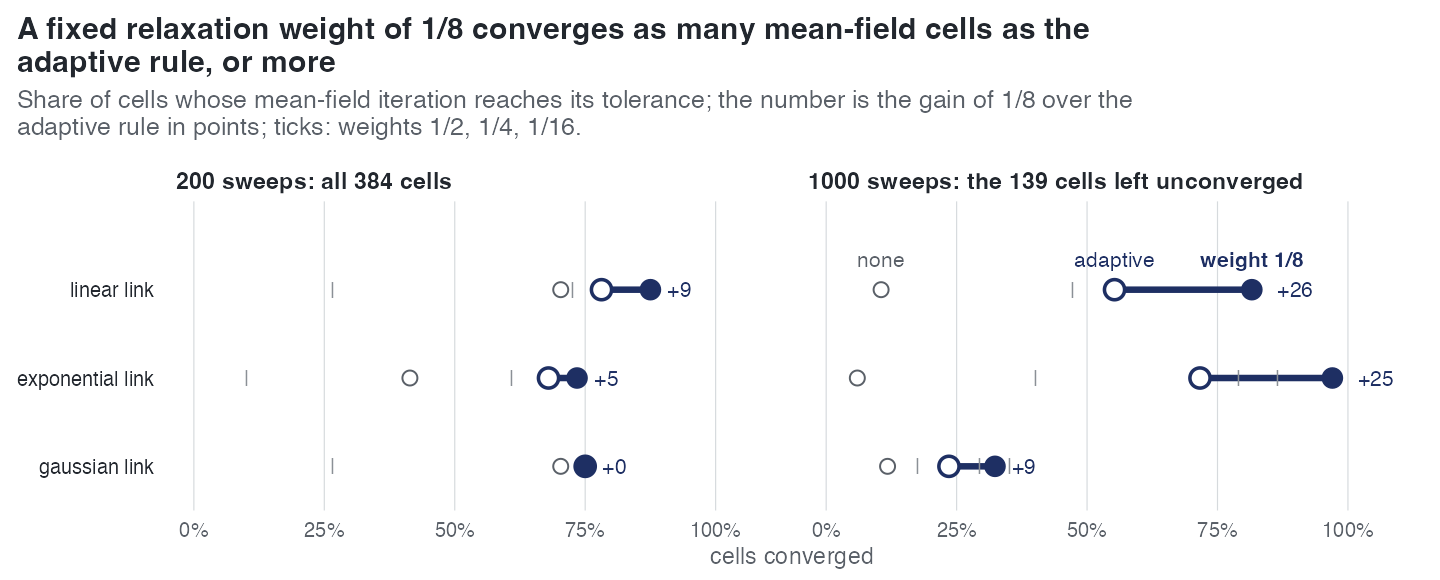
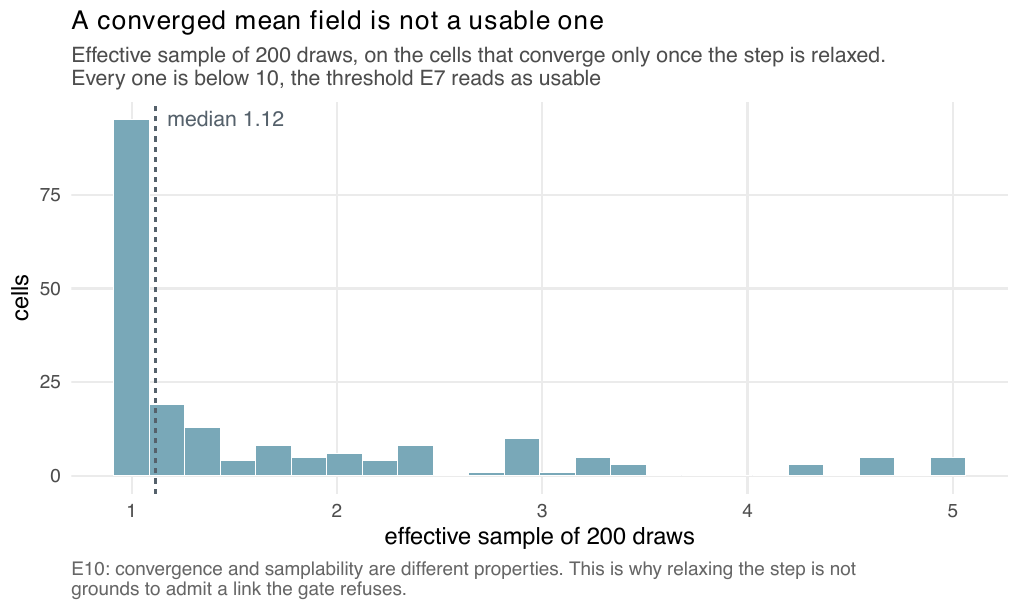
"auto" in percentage points: +9, +5, 0 at 200 sweeps and +26, +25, +9 at 1000.The proposal on a relaxed mean field. On the units that converge only once relaxed, the effective sample of 200 draws has median 1.12 (90th percentile 3.2) over 195 sampled units in E10, and 1.02 (90th 1.9) over 294 in E10b; by step at 1000 sweeps, ⅛ 1.01, 1/16 1.00, ¼ 1.03, "auto" 1.03.
E10b — the default at a fair budget
E10 had raised a caveat (adversarial review): its verdict was at 200 sweeps, where 1/16 failed mostly by running out of sweeps, and "auto", starting at 1, might be losing to the cap. At 1000 sweeps on the 139 diverging units, ⅛ converges 107 and "auto" 77; ⅛ leads on every link (31 vs 21 linear, 65 vs 48 exponential, 11 vs 8 gaussian). Some fixed step converges every unit "auto" does, and 33 more (record; a recount keyed on cell ids gives 11).
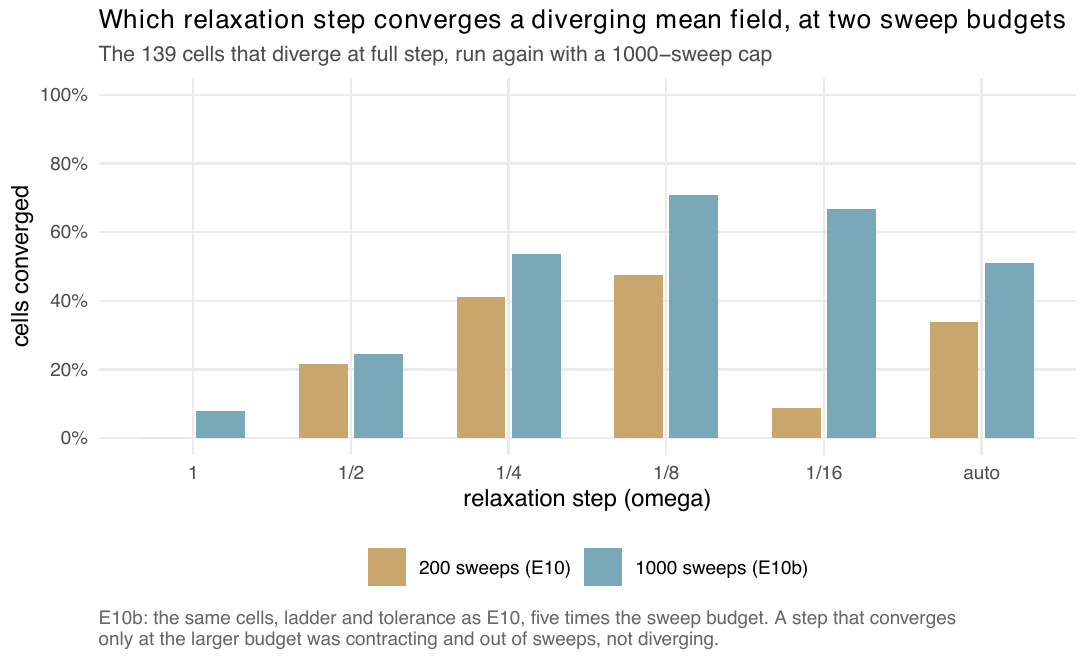
"auto" at both budgets.Conclusion
E10b's rule is met: "auto" converges fewer units than ⅛ at 1000 sweeps (77 against 107 of 139), so by the pre-set rule the default changes to a fixed 1/8, and the 200-sweep result is not a budget artefact. The default the package ships was then settled at the shipped sweep budget by E10c (below). The gaussian gate stays closed (the package has no gaussian link): a mean field that converges only under relaxation leaves a median effective sample of 1.02, so convergence and samplability are different properties and the step decides whether the iteration ends, not whether the draws are usable. Whether relaxation should be reported to the caller: no decision recorded. E10 measures the fixed point at given parameters; it says nothing about how often a fit meets a diverging sweep.
E10c: the default at the sweep budget the package ships
| Status | complete |
| Package build | 397bf3f (emphasis 1.0.0) |
| Driver / analysis | sim/E10c-shipped-budget.R, sim/E10c-analysis.R |
| Data | results/E10c/relaxation-shipped.csv (arm A), results/E10c/ess-contracting.csv (arm B), results/E10c/summary.txt |
Question
E10b's rule was met at a 1000-sweep cap, but the package calls the sweep with max_iter = NULL, which is 20 sweeps at \(\rho\) = 1 and 200 below (R/bdi.R). The author's decision on the relaxation default (audit of 2026-10-19) makes the change to ⅛ conditional on ⅛ also winning at that budget, and on ⅛ not costing effective sample where the iteration contracts: a small step has room for few contractions in 20 sweeps, and a mean field short of its fixed point changes the proposal.
Design
Arm A. E10's grid (648 units, the same seeds and rate vectors), with the simulation link named as linear (E10's default; 1.0.0 defaults to exponential), at \(\omega\) ∈ {1, "auto", ⅛}, each at the shipped budget and at E10's 200-sweep cap. The trees are E10's: the same 384 units carry a tree, with the same tip count on all 384, and the 200-sweep counts reproduce E10's exactly (full step 233, "auto" 283, ⅛ 302; 151 units diverge at full step). Arm B. The 760 dd trees of E45 (19 cells: turnover 0.10, 0.25, 0.40; 25 to 400 tips; \(\rho\) = 1 and 0.8; exponential link; generating values stored with each cell), one E-step of 200 draws from the surrogate proposal under "auto", ⅛ and full step at the shipped budget, the same seed for the three. A tree is contracting when the full-step sweep converges within 200 sweeps: all 760 are. cr is not run; its proposal has no mean-field iteration.
Pre-set rule
The default becomes a fixed ω = 1/8 only if (a) 1/8 converges at least as many of the 151 diverging units as "auto" does at the shipped budget, and (b) on the contracting trees of arm B the median effective sample under 1/8 is at least 0.9 times the median under "auto" (pooled over cells). Otherwise "auto" stays.
Results
Units converged at the shipped budget (arm A):
| full step | "auto" |
⅛ | |
|---|---|---|---|
| 151 diverging units | 0 | 37 | 48 |
| of which linear, \(\rho\) = 0.2 (21) | 0 | 10 | 21 |
| of which exponential, \(\rho\) = 0.2 (39) | 0 | 21 | 21 |
| of which gaussian, \(\rho\) = 0.2 (38) | 0 | 6 | 6 |
| of which linear and exponential, \(\rho\) = 1 (53) | 0 | 0 | 0 |
| all 192 units at \(\rho\) = 1 | 129 | 131 | 0 |
| all 192 units at \(\rho\) = 0.2 | 94 | 131 | 142 |
| all 384 units | 223 | 262 | 142 |
The whole gain of ⅛ over "auto" on the diverging units is 11 linear-link units at \(\rho\) = 0.2; on the exponential and gaussian links the two converge the same units. At \(\rho\) = 1, where the budget is 20 sweeps, ⅛ converges none of the 192 units, including 129 that converge at full step; "auto" converges every unit the full step does.
Arm B, 760 contracting trees: median effective sample of 200 draws 158.7 under "auto" and under the full step, 156.6 under ⅛ (ratio 0.987); median paired ratio 1.000 (10th to 90th percentile 0.93 to 1.05), below 0.9 on 39 of 760 trees. Per cell the median ratio lies between 0.978 and 1.007. The mean field converges within the budget on 560 of 560 trees at \(\rho\) = 1 under "auto" and on 0 of 560 under ⅛ (median final residual 0.92 against a tolerance of 10⁻⁴); at \(\rho\) = 0.8 (200 sweeps) it converges on 200 of 200 under both. On the same draws the log-likelihood estimate under ⅛ differs from "auto"'s by a median of 0.001 nats at \(\rho\) = 1 (10th to 90th percentile −0.07 to +0.06) and by 0 at \(\rho\) = 0.8; an E-step under ⅛ takes 1.4 times as long at \(\rho\) = 1 and 3.3 times at \(\rho\) = 0.8.
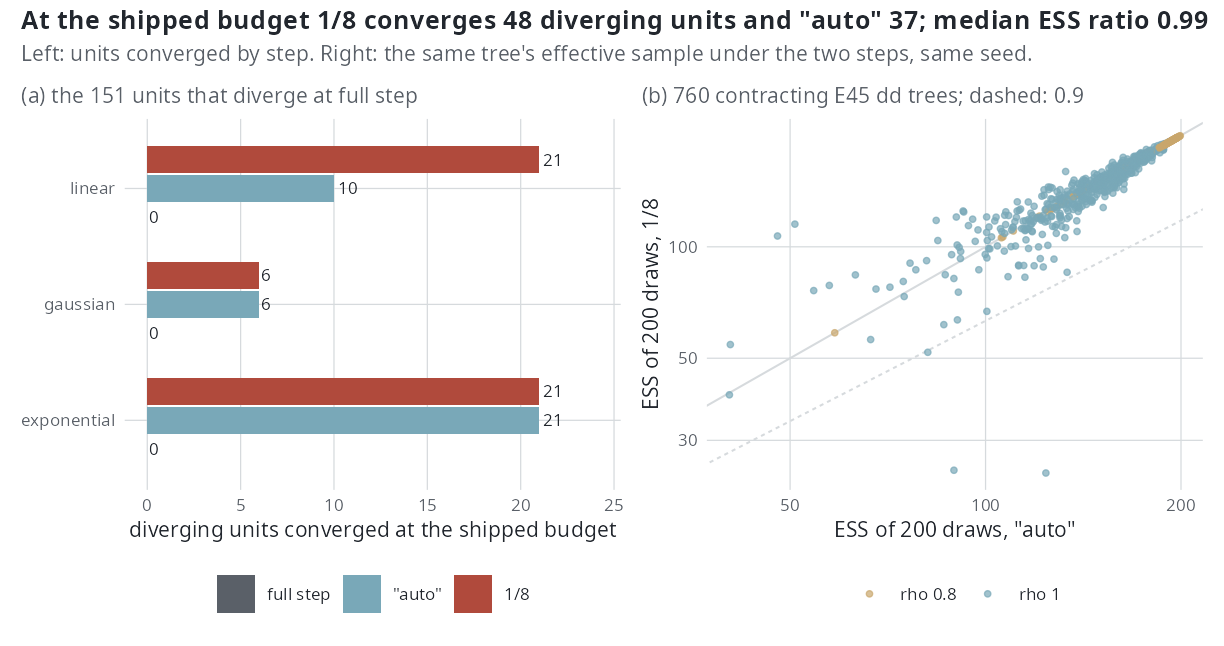
"auto" 37 within the shipped budget, the difference being linear-link units at ρ = 0.2. Right: each point is one E45 tree; the effective sample barely moves between the steps (median ratio 0.99), even though at ρ = 1 no mean field under ⅛ reaches its tolerance.Conclusion
The rule is met: (a) ⅛ converges 48 of the 151 diverging units against "auto"'s 37, and (b) the median effective sample under ⅛ on contracting trees is 0.987 of "auto"'s, above 0.9. What the rule does not weigh is the complete-sampling case. At $ ho$ = 1 the 20-sweep budget leaves the ⅛ mean field unconverged on all 192 units, against 131 for "auto", and on all 560 contracting trees of arm B, including every unit and tree that converges at full step; an E-step under ⅛ takes 1.4 times as long there (3.3 times at $ ho$ = 0.8), and the effective sample does not rise (ratio 0.987). Below $ ho$ = 1, where the budget is 200 sweeps, ⅛ converges more units than "auto" (142 against 131 of 192 at $ ho$ = 0.2). The whole gain of ⅛ over "auto" on the diverging units is 11 linear-link units at $ ho$ = 0.2.
Decision (the author, 2026-10-20). The default is "auto" at complete sampling ($ ho$ = 1) and a fixed ω = 1/8 when $ ho$ < 1. This departs from the literal wording of the rule, which would make ⅛ the default everywhere; it is taken because at $ ho$ = 1 a fixed ⅛ converges the mean field on 0 of 192 units within the shipped 20 sweeps against 131 for "auto", costs 1.4 to 3.3 times the E-step time, and gains no effective sample, while below $ ho$ = 1 it converges more than "auto". Every fit records the relaxation it used and whether the mean field converged.